
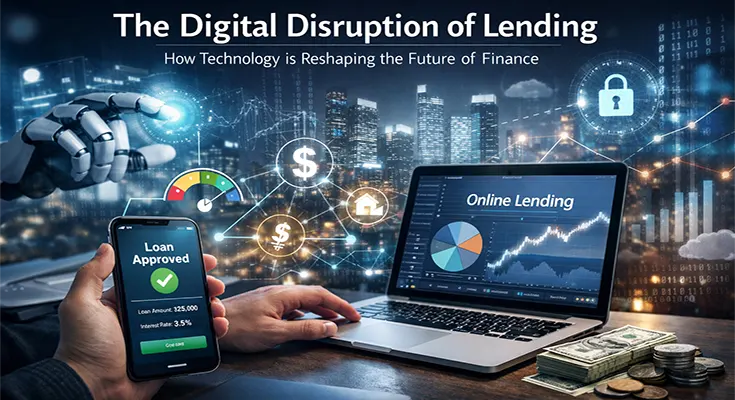
The lending industry, a bastion of traditional finance, is in the midst of a profound and disruptive transformation. The relentless march of technology is reshaping every aspect of the lending landscape, from the way loans are originated and underwritten to the way they are serviced and collected. This article will explore the digital disruption of lending, examining the key technologies that are driving this change and the impact they are having on both lenders and borrowers.
The digital revolution in lending is being fueled by a confluence of powerful technologies, including artificial intelligence (AI), machine learning (ML), big data, and blockchain. These technologies are enabling lenders to automate and streamline their operations, make more accurate and data-driven decisions, and provide a more personalized and convenient experience for borrowers.
One of the most significant impacts of technology on the lending industry has been the rise of digital lending platforms. These platforms, which are often operated by fintech startups, have completely reimagined the loan application process. Borrowers can now apply for a loan online or through a mobile app in a matter of minutes, without ever having to set foot in a bank branch. These platforms use sophisticated algorithms to analyze a borrower’s financial data and make a credit decision in real-time.
AI and ML are at the heart of this digital transformation. These technologies are being used to automate the underwriting process, which has traditionally been a manual and time-consuming task. AI-powered underwriting systems can analyze vast amounts of data, including a borrower’s credit history, income, and social media activity, to assess their creditworthiness with a high degree of accuracy. This not only speeds up the loan approval process but also helps to reduce the risk of default.
Big data is another key enabler of the digital lending revolution. Lenders now have access to an unprecedented amount of data about their customers, which they can use to personalize their products and services. For example, a lender might use a borrower’s purchase history to offer them a loan for a specific product or service. This data-driven approach to lending is helping to create a more personalized and relevant experience for borrowers.
Blockchain, the technology that underpins cryptocurrencies like Bitcoin, also has the potential to revolutionize the lending industry. Blockchain is a distributed ledger technology that can be used to create a secure and transparent record of all loan transactions. This could help to reduce the risk of fraud and make the lending process more efficient. While the adoption of blockchain in the lending industry is still in its early stages, it has the potential to be a truly transformative technology.
The digital disruption of lending is not just about technology; it is also about a fundamental shift in customer expectations. Today’s borrowers are accustomed to the convenience and personalization of digital services, and they expect the same from their lenders. They want a loan application process that is fast, easy, and transparent. They want to be able to track the status of their loan online and receive real-time updates. And they want to be able to interact with their lender through a variety of digital channels, including mobile apps, chatbots, and social media.
The traditional lending institutions that are able to adapt to this new digital reality will be the ones that thrive in the years to come. Those that are not will risk being left behind by a new generation of nimble and innovative fintech startups.
In conclusion, the digital disruption of lending is a powerful and irreversible trend. Technology is transforming every aspect of the lending industry, from the back office to the front lines. The lenders that embrace this change and use technology to create a more efficient, data-driven, and customer-centric business model will be the winners in this new era of finance. For borrowers, this digital revolution promises a future of greater access to credit, more personalized products and services, and a more convenient and transparent lending experience.
The Fintech Vanguard: Challengers to the Throne
The digital disruption of lending was not initiated by the incumbent financial giants, but by a wave of nimble and innovative fintech startups. These companies, unburdened by legacy systems and a traditional brick-and-mortar mindset, have been able to build lending platforms from the ground up, leveraging the latest technologies to create a more efficient and customer-centric experience. Companies like SoFi, LendingClub, and OnDeck have become household names, challenging the dominance of traditional banks in consumer and small business lending.
These fintechs have pioneered the use of online marketplaces and peer-to-peer (P2P) lending models. A P2P platform directly connects individual borrowers with individual or institutional investors, cutting out the traditional bank intermediary. This can result in lower interest rates for borrowers and higher returns for investors. While the P2P model has faced its share of challenges, it has undeniably forced the entire industry to rethink its approach to lending.
AI and Machine Learning: The New Underwriting Paradigm
The impact of AI and ML on the underwriting process cannot be overstated. Traditional underwriting has always been a blend of art and science, relying heavily on the experience and judgment of human underwriters. AI-powered systems are shifting the balance decisively toward science. These systems can analyze thousands of data points in a fraction of a second, identifying complex patterns and correlations that would be impossible for a human to detect.
For example, an AI model might find that a borrower’s educational background, employment history, and even their online shopping habits are predictive of their creditworthiness. By incorporating this alternative data into the underwriting process, lenders can make more accurate risk assessments, especially for “thin-file” borrowers who have a limited credit history. This has the potential to expand access to credit for millions of underserved consumers.
Furthermore, AI is being used to automate the entire loan origination workflow. Robotic process automation (RPA) can handle repetitive, rules-based tasks like data entry and document verification, freeing up human employees to focus on more complex and value-added activities. This not only reduces costs but also minimizes the risk of human error.
Big Data: The Fuel for Personalization
In the digital age, data is the new oil. Lenders are now able to collect and analyze vast amounts of data about their customers, from their transaction history and social media activity to their location data and web browsing behavior. This data can be used to create a highly personalized and contextualized lending experience.
Imagine a scenario where a borrower is browsing for a new car online. A lender, using big data analytics, could identify this borrower’s intent and proactively offer them a pre-approved auto loan at a competitive interest rate. This level of personalization is a far cry from the one-size-fits-all approach of traditional lending.
However, the use of big data also raises significant privacy concerns. Lenders must be transparent about the data they are collecting and how they are using it. They must also ensure that they have robust security measures in place to protect this sensitive information from cyber threats.
Blockchain: A New Foundation for Trust
While still in its early stages of adoption, blockchain has the potential to be the most transformative technology of all. A blockchain is a decentralized, immutable ledger that can be used to record and verify transactions in a secure and transparent manner. In the context of lending, a blockchain could be used to create a single, shared record of a loan’s entire lifecycle, from origination and underwriting to servicing and securitization.
This could have a number of profound benefits. It could reduce the risk of fraud by creating an unchangeable record of all loan-related activities. It could streamline the securitization process by making it easier for investors to verify the quality of the underlying assets. And it could empower borrowers by giving them more control over their own financial data.
The Incumbents Strike Back
Faced with the existential threat of fintech disruption, traditional banks are not standing still. They are investing heavily in their own digital transformation initiatives, partnering with fintech startups, and even launching their own digital-only brands. The line between a traditional bank and a fintech company is becoming increasingly blurred.
The banks have a number of advantages in this digital arms race. They have a massive customer base, a trusted brand, and a deep understanding of the regulatory landscape. However, they also have a number of disadvantages, including legacy IT systems, a bureaucratic culture, and a branch network that is expensive to maintain.
The future of lending will likely be a hybrid model, where the best of the old and the new come together. Traditional banks will need to become more like fintechs, and fintechs will need to become more like banks. The winners will be those who can provide a seamless, personalized, and trustworthy lending experience, regardless of the channel.
For borrowers, this digital arms race is a win-win. It is leading to more choice, lower costs, and a more convenient and transparent lending experience. The future of finance is digital, and the lending industry is at the forefront of this exciting and transformative journey.